
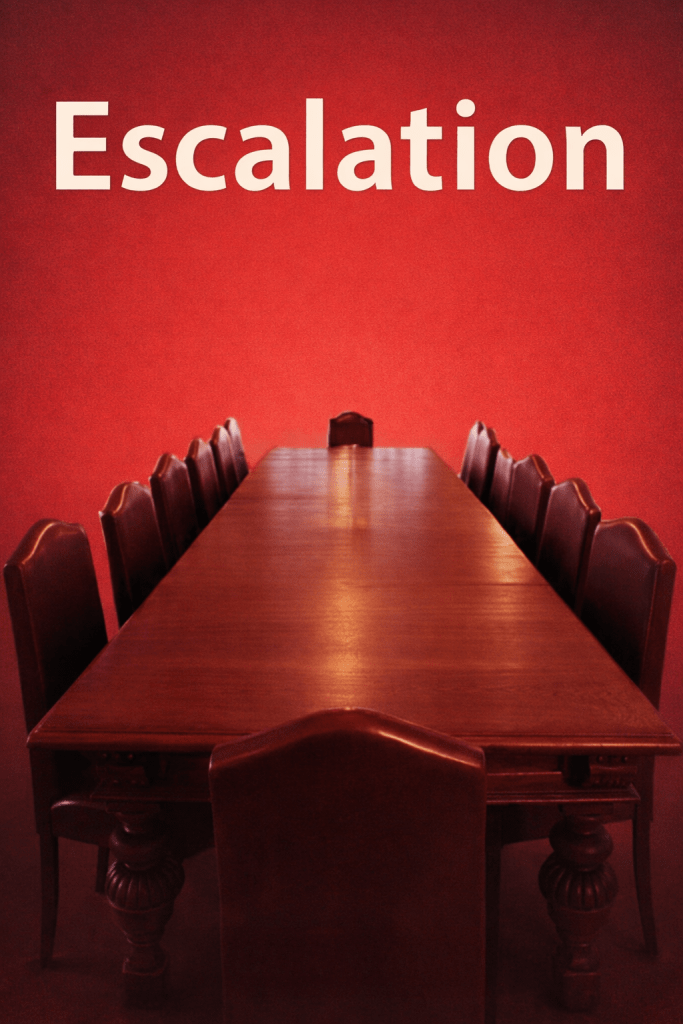
This week, I’ve brought you a story inspired by the idiocy that is wartime escalation policy. I wrote this a few months ago, but it’s feeling timely with all of our newfound conflict abroad. The black humor will continue until moral improves.
–Ashton
Sergeant Conrad was well versed in the art of warfare negotiation, but nothing could have prepared him for The Big Room. Deep in the bowels of a concrete-laden military facility, The Big Room was paneled in oak, headed by a set of twenty floor-to-ceiling screens, and funded by unsuspecting taxpayers. An impossibly long table made from a single piece of no doubt endangered wood ran down the center of the room. Plush armchairs flanked the sides. In the chairs were men and women of increasingly high pedigree. The closer one’s butt was to the screens, the more impressive said butt was.
So, it was with great pride that Conrad stepped near the head of the table and sat in the chair second from the front. The first chair was always left empty as a sign that everyone had room to improve. He ignored the rows of eyes staring back at him, some concerned, some purposefully unconcerned. Instead, he turned to the one gaze that mattered more than the rest: Madame Hererra.
The Madame, as she was often called, wore a clean-pressed grey suit emblazoned with her many military medals. She was fond of reminding everyone that they came from seven wars on six continents. The double dipping was once for oil and once because someone said the wrong thing at a state sponsored dinner party. The reasoning never mattered so long as it was viewed as justified by the global stage. That was where The Big Room came in.
“Conrad, thank you for joining us,” said The Madame. “We have a situation in the Eastern Territories.”
Conrad raised an eyebrow, but not so much as to appear over-emotional. One had to stay calm when given a seat at the table. “Which side?”
“Both sides.”
A skinny man at the far end of the table coughed in alarm.
Conrad hid his disgust at the sudden outburst and let out a thoughtful: “Hrrm.”
“Indeed,” said Herrera.
“Both sides have entered the conflict?”
“Both sides,” she agreed.
“With true force?”
“Show him,” said Herrera.
A gangly woman at the far end of the table tapped furiously at a tablet screen as if the technology embedded in the glass surface was the enemy. As she did so, images popped up on the large screens at the end of the table. The first showed a missile strike in the center of a crowded shopping area. The next, a series of unmarked cars pulling up to an embassy followed by a volley of gunfire. From the satellite image, it was difficult to tell the extent of the damage, but it certainly looked dramatic.
Conrad took in the information. A missile strike against a civilian target was bad, but under the right circumstances could be justified. The same could be said of the attack on the embassy. What mattered more was the statements from each country on why the acts were committed, not the outcome. “The missile strike was first?”
“Yes,” said Herrera.
“Who claimed responsibility.”
Madame Herrerra gestured toward a young man four chairs down with a series of smartphones in front of him. Conrad recognized him as Asher Polluck, the head of the state social media monitoring initiative. If someone gossiped about something online, Asher was there to code it, catalogue it, and share it from state-run accounts; assuming the goals of the poster aligned with those of the government.
“The supreme leader stated that there was a terrorist among the civilians. They used an M-24 missile meant to reduce the civilian casualties while ensuring the target did not escape.”
Conrad squeezed his hands together. M-24 missiles were quite large, but not as deadly as M-25 missiles which were meant for maximum spread and loss of life. Thankfully, no one had seen fit to use the M-26s which were sure to cause another World War. “Was the target neutralized?” Neutralized was a far more respectable word compared to killed.
“State media says yes, but it’s impossible to tell. For obvious reasons, no one has gone in to recover a body.”
“And the opposition?” asked Conrad.
“Are claiming this is unprovoked and the start of a conflict that will run for generations.”
Ahh, generational war. Conrad had lived through a few of them. Ghastly for those involved, wonderful for unfettered military spending and undeserved promotions. “And their attack on the embassy is retaliation?”
“Correct. They wanted to send a message specifically to the heads of state without harming civilians.”
“Measured, reasonable.” Conrad didn’t see the problem but knew better than to ask. So far, it was a typical tit for tat. “Who was killed in the embassy attack?”
“Several of our visiting diplomats,” answered Herrera.
“I see,” said Conrad. So, they were in The Big Room to determine their own level of escalation. “You want me to draft our response.”
“That is correct.”
“How many of ours were killed?”
“Two killed, one wounded.”
“Men, women?”
“One man, one woman. The wounded was a man as well.”
That made things interesting. If it had been all men, the public would have swallowed a smaller response, but a dead woman was something else entirely. Yes, there was a woman heading the country, but to the viewers at home, a woman was a mother, was a daughter, was to be protected with deadly force. It wasn’t logical, but it was politics, and Conrad excelled at politics. “Am I correct to assume our diplomats were accidental casualties?”
“Yes,” replied Asher. “The head of state has already sent us a personal apology and publicly stated that any deaths are deeply regretted.”
“Right.” Retaliation would be necessary, of course, but striking the right balance was tricky. Even if deaths were accidental, they were still deaths and needed to be answered. “Can someone pull up a list of military targets in the area for both sides, please.”
There was a murmur of “both sides?” that ran down the length of the table.
Madame Herrera folded her arms, a sign that the rest of the table should remain silent.
The murmur died instantly as if by firing squad.
As always, Conrad was in awe of the power The Madame wielded.
The screens populated with several satellite images of military bases across both regions.
“Talk me through your thinking,” said Madame Herrera, not chastising, simply interested. It was clear however that the line was thin.
“The accidental deaths must be answered for, I think we can all agree on that.”
“Yes of course,” said the table writ large.
“But the act of aggression that led to the deaths must also be answered for.”
Several heads nodded, but one lanky man in a sweat-through collar leaned forward. “Won’t that put us in conflict with both sides?”
Conrad smiled, the man’s voice had cracked, weakness to his own dominance. “We will put out an order for the bases to evacuate before we strike. That way we send a message.”
“Enlighten us on that message,” said Madame Herrera. Tension still permeated her posture, but Conrad also saw a glint of excitement in her eyes. The Madame loved many things, but pressing the big red button that launched strikes was at the top of the list.
“You have done a bad thing. We could kill you if needed, but we are benevolent and choosing not to. Both sides will thank us for our tolerance privately, show outrage publicly, and move on from the conflict in a month.” In practice, every country wanted a little bit of conflict. Elections were won on successful conflict, when it was short lived. Standing in front of a bombed military base could buy the leaders of both countries a few more years in office.
“Could we not just assassinate the leader and be done with it?” asked Herrera. There was an edge to her voice. She was itching for a “ladies and gentlemen” press conference.
We save the assassinations for election years. Conrad tempered his voice. “If we assassinate their leader, the escalation will not be proportional. They will then be forced to retaliate in turn. I can’t be positive, but if we assassinate their leader, I wouldn’t be surprised to see one of our small island nations bombed as a token of their displeasure. As long as they kept civilian casualties below a hundred or so, that would be a fair retaliation and then we would be in the position of deescalating.”
“Well, we can’t have that,” said Herrerra.
There was only one thing worse than prolonged conflict and that was being seen as the first person to end a conflict. The person to de-escalate or back down did not get the benefits of wartime votes.
“My suggestion is that we strike training facilities on both sides with a slightly larger payload against our embassy combatants. This should stop the conflict dead in its tracks.”
“Seems reasonable,” said Herrera. “Martin, get on the phone with the leaders, let them know the strikes are coming and the consequences if they don’t deescalate.”
A trim military man toward the middle of the table picked up a pair of red phones, dialing both nations simultaneously. “Yes sir, you have about a minute to evacuate. No ma’am, the fighters are already in the air.” The fighters were always in the air. “The troops are already on leave? Wonderful. Best wishes with the election. Yes, sir, we’ll aim a little bit to the left. Wouldn’t want to hit any munitions. Of course. Thank you, sir. Best of luck.” Martin hung up both phones. “Go for strike in five.”
Madame Herrera pulled out an oversized red button with the white letters “STRIKE” emblazoned across the top. It had been custom made to celebrate her second term in office. “Would you like to do the honors, Conrad?”
Conrad smiled, lips tight. Of course he wanted the honors, but asking was a test. “No Ma’am, but I appreciate the opportunity. The controls are yours.”
Herrera nodded. “Keep this up and you might make second chair.”
Nothing would have pleased Conrad more, but he kept that to himself. The table was silent as they passed the minutes. A red countdown clock appeared on the screens. Conrad watched the numbers tick down.
The clock hit zero and Madame Herrera pressed the red button. All at once the screens lit up in flashes of white as high altitude missiles struck their targets. There was a brief silence as the debris settled and then the table erupted in applause. Madame Herrera stood, took a small bow and then said: “Alright, who wants lunch?”
If you enjoy my short fiction, consider buying my newest comedic sci-fi novel, One Night at Kedasi. It is available wherever books are sold.
 Ashton Macaulay