
Over the last six months, I’ve been struggling whenever I’m tasked with reviewing something (a movie, a book, a bag of limited-edition chips). Looking back through my history on Letterboxd (a film rating app), I noticed I was highly inconsistent with what I gave my coveted – I’m sure someone covets it – five-star rating to. For example, take a look at the four films I gave five stars to this year:
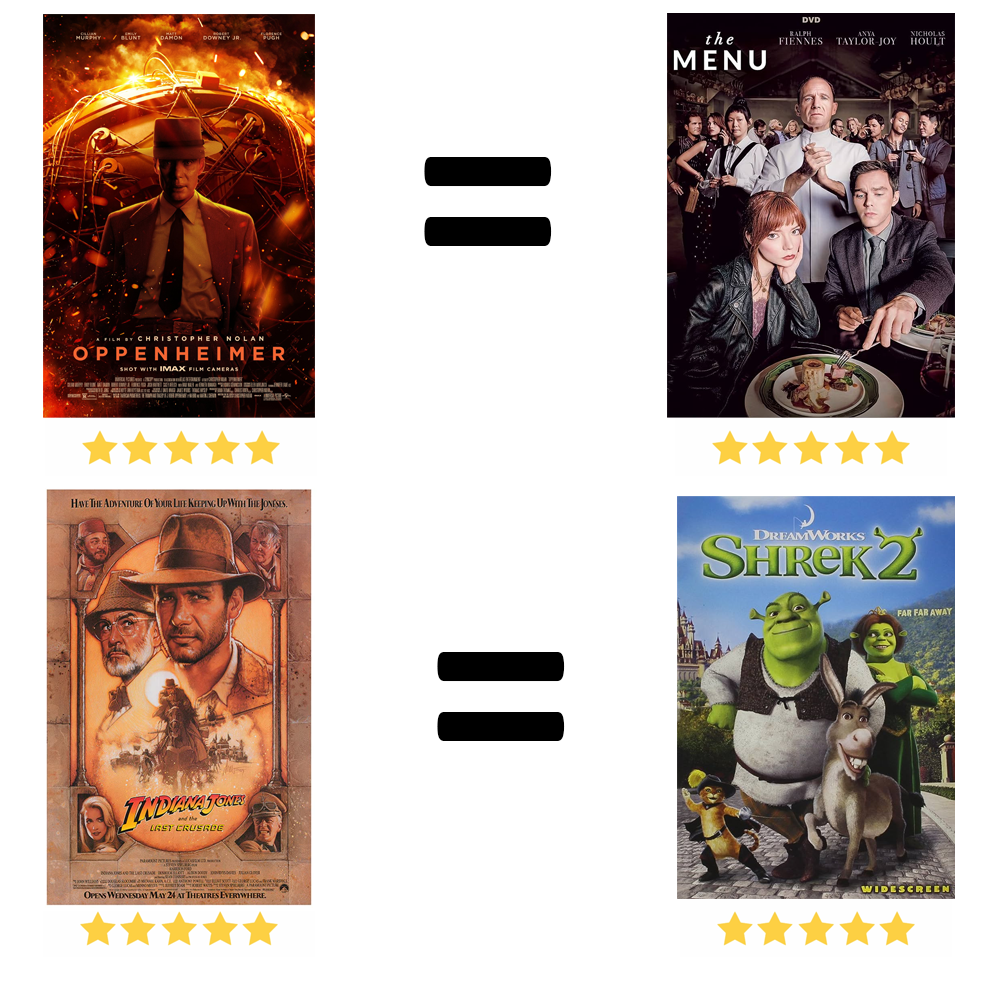
Now, one might argue that putting Shrek 2 at the same level as Oppenheimer and The Last Crusade is dicey, but after thinking about it, I stand by it. While they are fundamentally different types of content, I had the same feeling after watching both Shrek 2 and Oppenheimer; I wanted to watch them again. While many might argue that Oppenheimer is a better film, on a scale of enjoyment, I’d put them around the same level personally. So, I set out to make a scale that would properly address the Shrekenheimer phenomenon. With that in mind, here’s what I came up with:

When creating the criteria for my new scale, I wanted to help myself out of a common trap: feeling stupid because I don’t like a movie, or feeling embarrassed that I DO like a movie. For example, I really didn’t like Triangle of Sadness:

Sure, I can see that the movie is well made, but I can almost guarantee you I’m never going to watch it again. Rather than being embarrassed about not getting it, or feeling stupid for not liking artsy films, I can just say, according to my super objective scale, that’s a 2-star film.
That’s a long-winded way of saying, here’s the new way I’m going to be reviewing things. People may not agree with it, but at least it will keep me consistent. Below is the scale with a few examples of how I’ve rated films this year.

With all that out of the way, I’m going to go write a review for Blackberry, because let me tell you, that was a good one! More to come soon.
 Ashton Macaulay
13 thoughts on “What does a review score mean anyway?”